
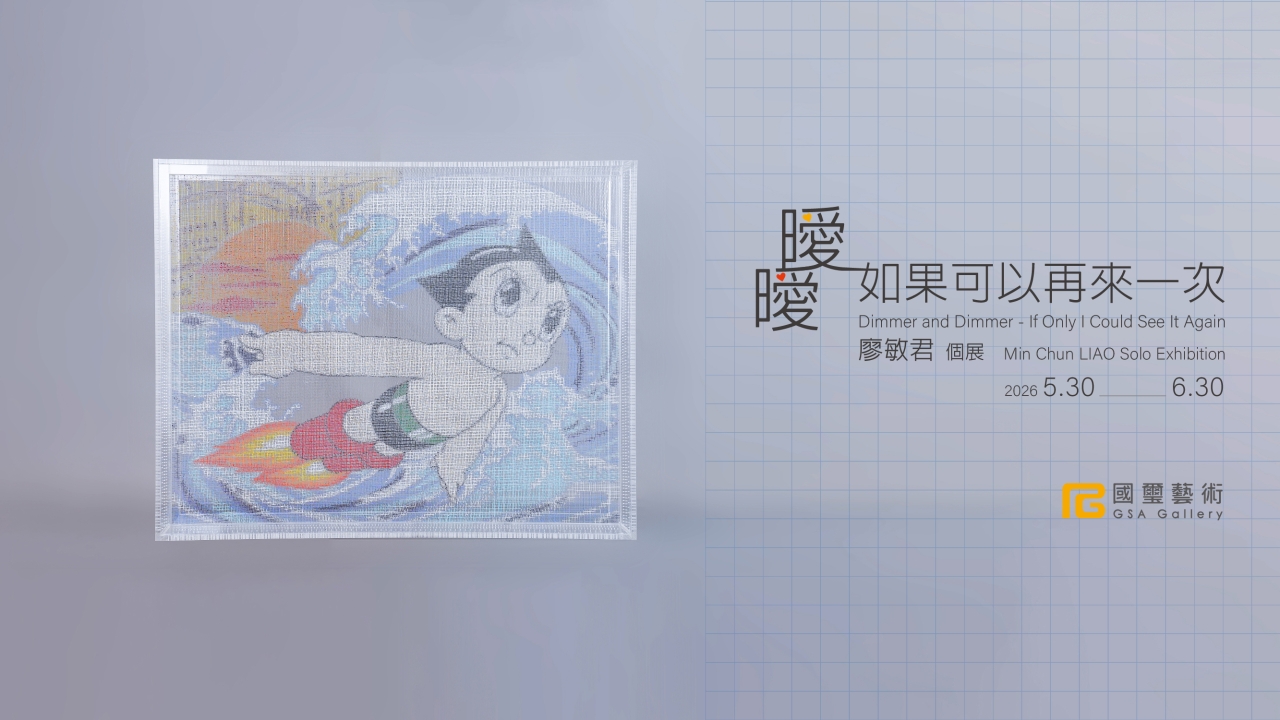
Dimmer and Dimmer - If Only I Could See It Again-Min Chun LIAO Solo Exhibition 曖曖-如果可以再來一次-廖敏君個展
May 30 - May 30, 2026
Memory as a Social Form — Min Chun LIAO’s Creative Path Concerning Drift, Obscuration, and Afterimages
PAI Shih-Ming
Professor, Department of Fine Arts, National Taiwan Normal University
Time continuously moves forward in a way that never ceases, yet its origin and end remain unseen. The distances between before and after, old and new, far and near are difficult to measure, as if formed by an infinite network woven by invisible hands, passing through different generational transitions, states of life, and collective memories. From the perspective of individual growth experiences, childhood, adolescence, youth, adulthood, middle age, and old age classifications measured by “years” clearly embody a concept of continuous yet segmented time, yet they still remain ambiguous. Time has never paused for anyone or any moment in life, yet human life histories must be defined according to its divided concepts. The transitions and evolutions between different stages carve out a kind of intangible, indescribable emptiness, ambiguity, and change.
Extending from the individual to the collective, and from the singular to the plural, time begins as a linear state but ultimately becomes a network of entanglements. In other words, no individual can escape society, and society therefore becomes the collective term for individuals, impossible to separate. The classifications of time mentioned above apply to all individuals, and through the interweaving exchanges among groups, complex interpersonal relationships are formed. Although individuals and groups may categorize different states of life through these conceptual vocabularies, time itself still appears intangible and elusive. How does time become visible for individuals? Or further become a means through which groups reflect one another? Perhaps only through memory.
Memory can be regarded as one of the most important mediums through which humans perceive the existence of time, especially for time that exists in disappearance or has already passed.
As fragments of memory continue to awaken, relationships between individuals and groups seem to generate entirely new connections, reappearing almost like rebirth. From unfamiliarity to familiarity, from emptiness to intersection, crossing differences toward homogeneous connection, the past is reshaped and reconstructed in certain forms. Therefore, memory has never been merely private property, but rather a “socialized” product and result. More often, it must rely upon mutual connection, supplementation, and assemblage among groups in order to generate meanings closer to reality.
German female sociologist Angela Keppler (1954– ) once stated: “The remembered present of the past, like the present in which remembering takes place, is a social construction concerning a meaningful world of experience and action. These constructions are maintained through collective memory.” (Referenced from Tischgespräche, 1994.) From this, we may understand that individuals often establish social and interpersonal relationships through recollective narration and exchange with groups, building relationships of “similarity” or “closeness,” while preserving and transmitting memories through such communicative processes.
Much of Min Chun LIAO’s creative practice over the past decade originates from memories awakened through family photographs. The disappearance of childhood and past times, together with the hidden dispersal of family members behind them, became the starting point of this writing constructed jointly through autobiography and family history. She once stated: “The work Saying Goodbye Is Too Difficult was an important turning point in my artistic practice” (2017). Through an ambiguous method between clarity and blurriness, within a black-and-white tonal field carrying memorial and commemorative qualities, the work outlines scenes of the past and vanished youth that have lost color and retain only contours through a simple and direct linear narrative framework. Through partial spotlight illumination, a suddenly revealed parent-child photograph emerges, resembling a frozen moment passing through time into the abyss of memory.
Over the following years, within the “desire” to reconstruct relationships and forms with her father and family, LIAO continuously attempted to reconnect these “broken” relationships through various “visible” forms, rediscovering and redefining herself. For her, longing resembles countless threads radiating in all directions between the labyrinth of imagination and the matrix of rationality. The remaining memories and frozen moments within photographs guide her crawling forward.
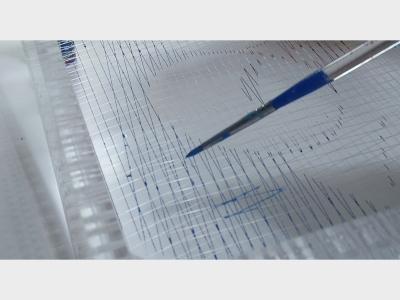
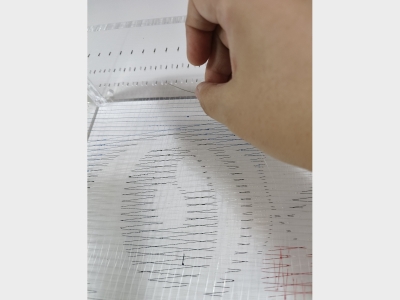
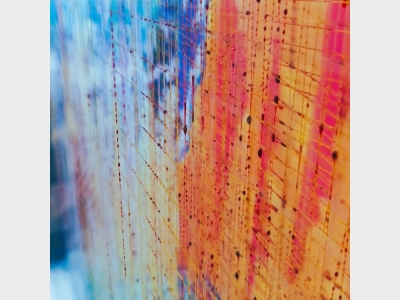
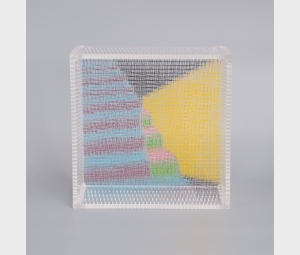
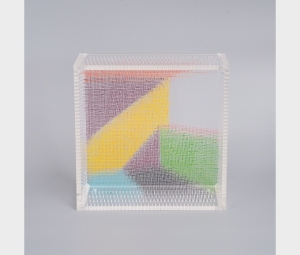
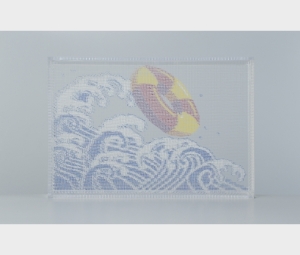
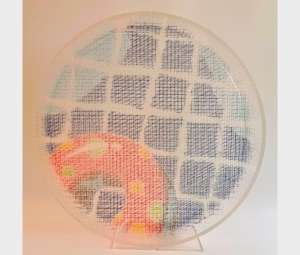
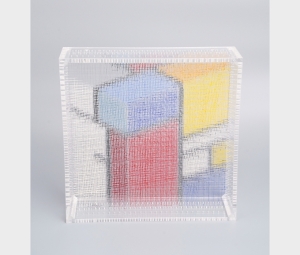
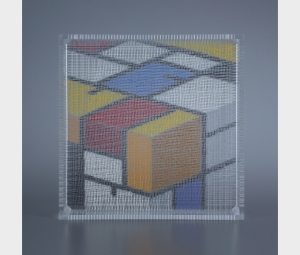
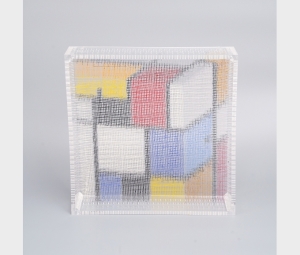
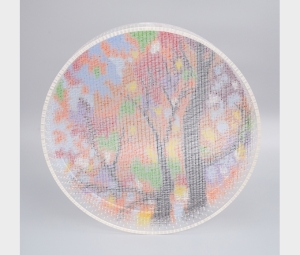
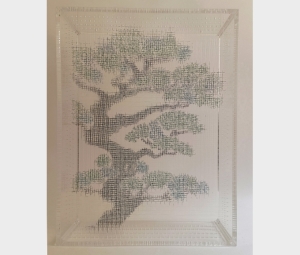
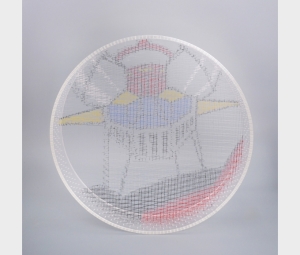
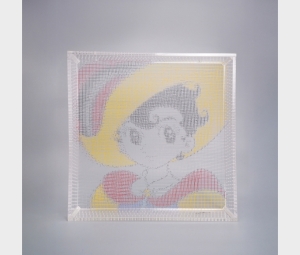
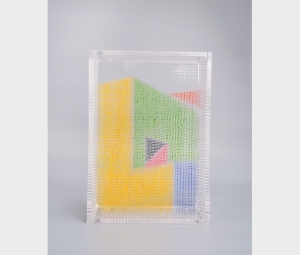
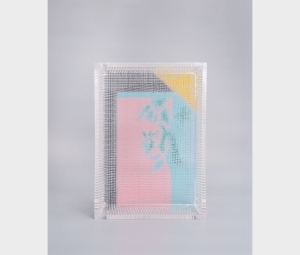
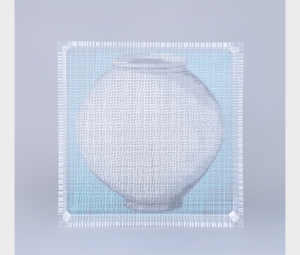
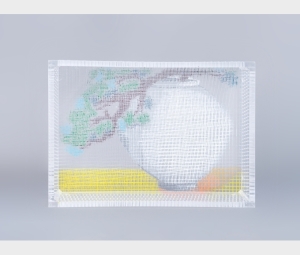
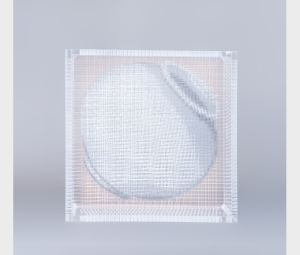
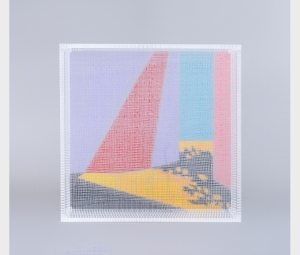
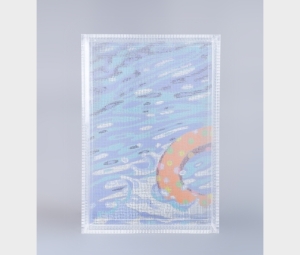
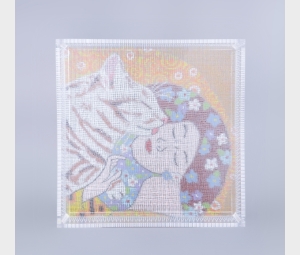
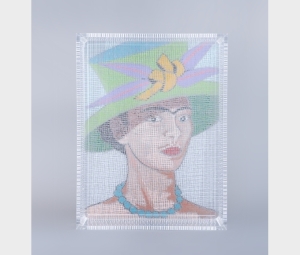
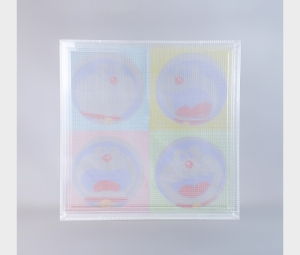
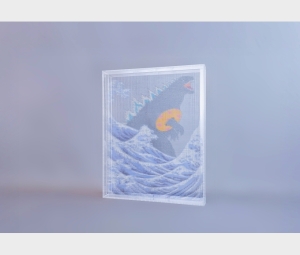
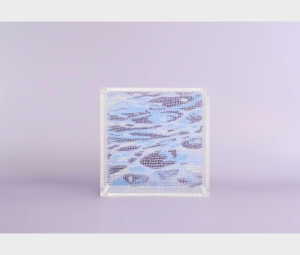
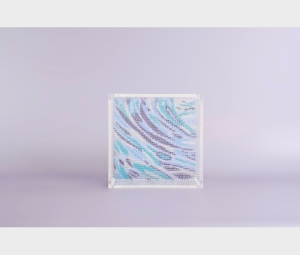
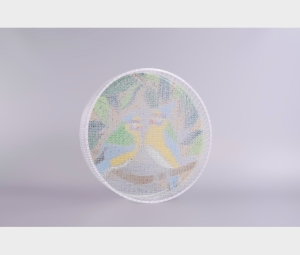
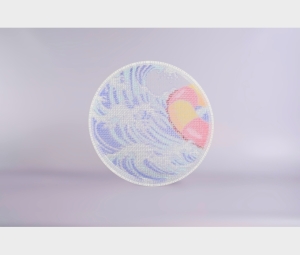
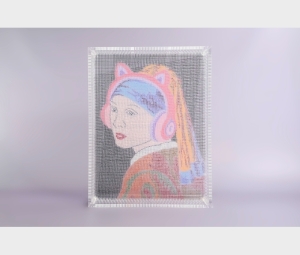
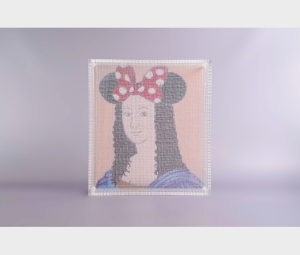
Through the weaving and interlacing of transparent industrial carbon fiber materials and colored points, she creates spiritual illusions filled with drifting movement, front-and-back obscuration, and afterimage-like autobiographical grammar. Through this creative behavior and the crossing and summoning of longing, the three-dimensional overlapping of materials, spaces, forms, and colors seems to shape retrospective images through a form of composite “rebirth,” becoming her synchronic creative logic and visual vocabulary connecting here and there, past and present, the deceased and the living.
In recent years, the successive passing of her mother and cat-like family pets has deepened her unique life experience of wandering between memory and forgetfulness. Combined with self-reflection and even self-mockery regarding different stages of personal growth, from childhood and adolescence to her parents’ old age and her current self, LIAO appears to deliberately flip through albums, constantly searching for fragments of memory between parents, children, and personal life that may still remain preserved.
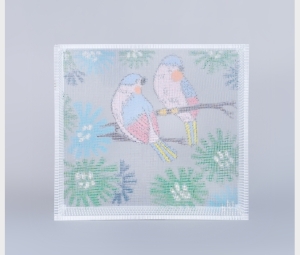
Particularly, the contradictory relationship between the series Quietly Waiting for the Arrival of Wind and Wind Does Not Come highlights social relationships between parents and children that were never realized or remain on the verge of collapse. Today, those fragmented images of plants, potted flowers, birds, and architectural corners connecting one another can only be regarded as annotations and notes added afterward as compensation.
Meanwhile, the series Our Once can be seen as an extension of LIAO’s ongoing opening of memory as a social construct or social form, still belonging to a different collective memory within an autobiographical writing system.
Cartoon characters such as Pink Panther, Candy Candy, Popeye, Snow White, as well as Rubik’s Cubes, extending to this year’s (2026) series Woman Beyond Time and Space, demonstrate how she reexamines and reconstructs the “identities” once possessed by herself and people of the same generation through both diachronic and synchronic sorting of beautiful memories from the process of growing up. She gives form to youth and everyday life that have already disappeared, where the self equals others, allowing history to reappear before our eyes and compensating for the melancholy, repression, and forgetting caused by the passage of time.
From documentation, representation, metaphor, symbolism, to meta-costuming, Min Chun LIAO has already developed a broader and more diverse creative path. Through the visual restoration of family history, she fills the fragmented, broken, and lost puzzles belonging to herself and her generation, while reconstructing social constructs of different forms and meanings within this process of examination. Her works reveal collective consciousness concerning growth, empathy, communication, and transcendence, while simultaneously constructing an entirely new “human relationship” capable of connecting people more deeply.
作為社會形式的記憶—廖敏君有關游移、遮蔽與殘影的創作路徑
國立臺灣師範大學美術系教授
白適銘
時間,以從未止息的方式不斷前進,卻不見其來處與盡頭,前與後、舊與新、遠與近之間的距離難以蠡測,彷若由一雙隱形的手所編織而成的無窮網絡,穿梭在不同的世代交替、生命狀態與集體記憶之中。從個人成長的經驗角度來說,童年、少年、青年、壯年、中年至老年,如此以「年」為度量單位的分類,雖清晰體現一種持續卻彼此分割的時間概念,卻仍模糊不清。時間,未曾為任何人及其人生片刻停留,人的生命履歷卻必須依附在其切割概念下而被定義,不同階段的遞嬗衍化,鑿刻著似有若無而難以言說的虛無、模糊與變動。
由個人延展到群體、從單數擴張到複數,時間始於一種線性狀態,卻終於彼此交纏的網絡秩序。亦即,沒有單一的個體可以逃離社會,社會亦因此成為單一個體的總稱,無法進行切割。上述不同單位的時間分類,適用於所有個人,透過群體間你來我往的交織,形成錯綜複雜的人際關係。雖然,個人或群體得以用上述詞彙概念分類生命中的不同時間狀態,時間仍然顯得虛無飄渺,時間如何為個人顯影?或進而成為群體之間相互映照的憑藉?恐怕只能憑藉記憶。記憶,可謂人類感知時間存在的重要媒介,特別是對處於消逝之間及已成過往狀態中的時間。
隨著片段記憶不斷被喚醒,個人與群體之間的關係似乎產生全新的連結,有如再生般地重現,從陌生到熟稔、由空白到交集,跨越差異轉進同質的連結,促使過往以某種形式被重新賦形及再造。故而,記憶從來都不只是個人私有之物,而是「社會化」的產物與結果;更多的情況,必須依附在群體的相互連結、補綴及拼組的交換過程中,產生更接近事實的意義重現。
德國女性社會學家安吉拉‧凱普勒(Angela Keppler, 1954-)曾說:「人們所回憶的往日的當今,和人們回憶時所立足的現在的當今一樣,都是關於一個有意義的經歷和行為世界的社會構造物。這些構造物,依賴人們的集體記憶得到保持。」(參考《餐桌邊的談話—以家庭談話為例論溝通集體化形式》(Tischgespräche, 1994)可以理解,個人經常憑藉回憶性的敘述,與群體產生交流/交換,建立彼此「相似」或「相近」的社會性/人際關係,同時藉由此種形式的「溝通交流的過程」保留或傳承其中的記憶。
廖敏君近十年來的創作,在很大部分,來自於家庭照片所喚起的記憶察覺,童年以往時光的消逝及其背後隱藏的家人離散,成為她這段由自傳與家族史共構而成的書寫起點。她曾自述:「《說再見太難》(下圖)這件作品是我創作上的一個重要轉折點」(2017),這件作品以一種介於清晰與模糊之間的曖昧手法,在帶有追悼或紀念性的黑白色域中,以一種簡單直接的線性敘事框架,勾勒失去色彩及僅存輪廓的往日情景、已逝青春,並藉由燈光的局部探照,突顯因為被突然發現而浮出的親子合影,彷若穿越時間的定格進入記憶深淵的瞬間。
往後數年,廖敏君在所謂重新建構與父親/家人關係及樣態的「渴望」之中,不斷嘗試透過各種「有形」的形式鏈接「斷裂」的彼此,重新發掘並定義自我。對她來說,思念像是千絲萬縷般的線頭,以各種方向漫射於想像的迷宮與理智的矩陣之間,僅存的記憶與照片中凝結的片刻,正引導她匍匐前行。她藉由透明的工業材料碳纖維及色點的穿梭往來,綴織成一幅幅充滿游移、前後遮蔽及宛若殘影般帶記傳體文法的心靈幻像。藉由此種創作行為及召喚思念的交錯與穿越,材質、空間、形狀與色彩的三維重疊,似乎為其藉由一種複合式「再生」所賦形的回顧圖像,成為其所謂連結彼與此、過往與現今或已逝與現存並在的「共時性」創作邏輯與視覺語彙。
近來,母親或宛若家人貓咪寵物的相繼離去,加深其對此種在記憶與失憶兩端徘徊不定的特殊生命體驗,兼之來自對個人不同成長歷程的自我檢視甚或自我嘲諷,從童年、青少年跨越至父母老年、當下的自我等之間多重的存在與逝去,廖敏君像是刻意翻閱相簿般地,不斷尋找與父母親子、個人生活一切間可能仍被保存的片刻記憶。尤其,「靜靜等待風的到來」與「風不來」兩個系列之間的矛盾對應,突顯此種親子間未曾實現或徘徊於瓦解邊緣的社會性關係,於今,這些由連結彼此的植物、盆栽、鳥類、建築角落等的片段圖像,只能說是事後彌補的附註與筆記。同時,「我們的曾經」系列可以視為廖敏君將記憶作為一種社會構造物或社會形式而被持續打開而出的主題延伸,仍然屬於一種自傳式書寫體系下的不同集體記憶。
頑皮豹、小甜甜、大力水手、白雪公主等的卡漫人物或魔術方塊,直至今年(2026)的「超越時空之女」系列,她藉由成長過程美好記憶的「歷時性」或「共時性」雙向梳理,回視/重構自身或同時代人曾經存在的「身分」,賦予那種自我等於他人已然消逝的青春日常,讓歷史再現眼前,彌補時間流逝造成的感傷、壓抑及遺忘。從紀錄、再現、隱喻、象徵到後設變裝,廖敏君已然開展出更為寬闊多元的創作路徑,藉由家族史的視覺復原,進而為她個人及同世代填補已然殘缺、破碎及失落的拼圖,並在此種檢視中重塑不同形式、意義的社會構造物,展現有關成長、共感、溝通、跨越等的集體意識,同時建構一種更得以連結彼此的全新「人物關係」。
|展 期 Date|2026.5/30 ~ 6/30
|開幕座談會 Opening|5/30 (六) 下午2:30
|與談人Panelist|白適銘 教授 Professor PAI Shih-Ming
|地 點 Venue|國璽藝術GSA Gallery
PAI Shih-Ming
Professor, Department of Fine Arts, National Taiwan Normal University
Time continuously moves forward in a way that never ceases, yet its origin and end remain unseen. The distances between before and after, old and new, far and near are difficult to measure, as if formed by an infinite network woven by invisible hands, passing through different generational transitions, states of life, and collective memories. From the perspective of individual growth experiences, childhood, adolescence, youth, adulthood, middle age, and old age classifications measured by “years” clearly embody a concept of continuous yet segmented time, yet they still remain ambiguous. Time has never paused for anyone or any moment in life, yet human life histories must be defined according to its divided concepts. The transitions and evolutions between different stages carve out a kind of intangible, indescribable emptiness, ambiguity, and change.
Extending from the individual to the collective, and from the singular to the plural, time begins as a linear state but ultimately becomes a network of entanglements. In other words, no individual can escape society, and society therefore becomes the collective term for individuals, impossible to separate. The classifications of time mentioned above apply to all individuals, and through the interweaving exchanges among groups, complex interpersonal relationships are formed. Although individuals and groups may categorize different states of life through these conceptual vocabularies, time itself still appears intangible and elusive. How does time become visible for individuals? Or further become a means through which groups reflect one another? Perhaps only through memory.
Memory can be regarded as one of the most important mediums through which humans perceive the existence of time, especially for time that exists in disappearance or has already passed.
As fragments of memory continue to awaken, relationships between individuals and groups seem to generate entirely new connections, reappearing almost like rebirth. From unfamiliarity to familiarity, from emptiness to intersection, crossing differences toward homogeneous connection, the past is reshaped and reconstructed in certain forms. Therefore, memory has never been merely private property, but rather a “socialized” product and result. More often, it must rely upon mutual connection, supplementation, and assemblage among groups in order to generate meanings closer to reality.
German female sociologist Angela Keppler (1954– ) once stated: “The remembered present of the past, like the present in which remembering takes place, is a social construction concerning a meaningful world of experience and action. These constructions are maintained through collective memory.” (Referenced from Tischgespräche, 1994.) From this, we may understand that individuals often establish social and interpersonal relationships through recollective narration and exchange with groups, building relationships of “similarity” or “closeness,” while preserving and transmitting memories through such communicative processes.
Much of Min Chun LIAO’s creative practice over the past decade originates from memories awakened through family photographs. The disappearance of childhood and past times, together with the hidden dispersal of family members behind them, became the starting point of this writing constructed jointly through autobiography and family history. She once stated: “The work Saying Goodbye Is Too Difficult was an important turning point in my artistic practice” (2017). Through an ambiguous method between clarity and blurriness, within a black-and-white tonal field carrying memorial and commemorative qualities, the work outlines scenes of the past and vanished youth that have lost color and retain only contours through a simple and direct linear narrative framework. Through partial spotlight illumination, a suddenly revealed parent-child photograph emerges, resembling a frozen moment passing through time into the abyss of memory.
Over the following years, within the “desire” to reconstruct relationships and forms with her father and family, LIAO continuously attempted to reconnect these “broken” relationships through various “visible” forms, rediscovering and redefining herself. For her, longing resembles countless threads radiating in all directions between the labyrinth of imagination and the matrix of rationality. The remaining memories and frozen moments within photographs guide her crawling forward.
Through the weaving and interlacing of transparent industrial carbon fiber materials and colored points, she creates spiritual illusions filled with drifting movement, front-and-back obscuration, and afterimage-like autobiographical grammar. Through this creative behavior and the crossing and summoning of longing, the three-dimensional overlapping of materials, spaces, forms, and colors seems to shape retrospective images through a form of composite “rebirth,” becoming her synchronic creative logic and visual vocabulary connecting here and there, past and present, the deceased and the living.
In recent years, the successive passing of her mother and cat-like family pets has deepened her unique life experience of wandering between memory and forgetfulness. Combined with self-reflection and even self-mockery regarding different stages of personal growth, from childhood and adolescence to her parents’ old age and her current self, LIAO appears to deliberately flip through albums, constantly searching for fragments of memory between parents, children, and personal life that may still remain preserved.
Particularly, the contradictory relationship between the series Quietly Waiting for the Arrival of Wind and Wind Does Not Come highlights social relationships between parents and children that were never realized or remain on the verge of collapse. Today, those fragmented images of plants, potted flowers, birds, and architectural corners connecting one another can only be regarded as annotations and notes added afterward as compensation.
Meanwhile, the series Our Once can be seen as an extension of LIAO’s ongoing opening of memory as a social construct or social form, still belonging to a different collective memory within an autobiographical writing system.
Cartoon characters such as Pink Panther, Candy Candy, Popeye, Snow White, as well as Rubik’s Cubes, extending to this year’s (2026) series Woman Beyond Time and Space, demonstrate how she reexamines and reconstructs the “identities” once possessed by herself and people of the same generation through both diachronic and synchronic sorting of beautiful memories from the process of growing up. She gives form to youth and everyday life that have already disappeared, where the self equals others, allowing history to reappear before our eyes and compensating for the melancholy, repression, and forgetting caused by the passage of time.
From documentation, representation, metaphor, symbolism, to meta-costuming, Min Chun LIAO has already developed a broader and more diverse creative path. Through the visual restoration of family history, she fills the fragmented, broken, and lost puzzles belonging to herself and her generation, while reconstructing social constructs of different forms and meanings within this process of examination. Her works reveal collective consciousness concerning growth, empathy, communication, and transcendence, while simultaneously constructing an entirely new “human relationship” capable of connecting people more deeply.
作為社會形式的記憶—廖敏君有關游移、遮蔽與殘影的創作路徑
國立臺灣師範大學美術系教授
白適銘
時間,以從未止息的方式不斷前進,卻不見其來處與盡頭,前與後、舊與新、遠與近之間的距離難以蠡測,彷若由一雙隱形的手所編織而成的無窮網絡,穿梭在不同的世代交替、生命狀態與集體記憶之中。從個人成長的經驗角度來說,童年、少年、青年、壯年、中年至老年,如此以「年」為度量單位的分類,雖清晰體現一種持續卻彼此分割的時間概念,卻仍模糊不清。時間,未曾為任何人及其人生片刻停留,人的生命履歷卻必須依附在其切割概念下而被定義,不同階段的遞嬗衍化,鑿刻著似有若無而難以言說的虛無、模糊與變動。
由個人延展到群體、從單數擴張到複數,時間始於一種線性狀態,卻終於彼此交纏的網絡秩序。亦即,沒有單一的個體可以逃離社會,社會亦因此成為單一個體的總稱,無法進行切割。上述不同單位的時間分類,適用於所有個人,透過群體間你來我往的交織,形成錯綜複雜的人際關係。雖然,個人或群體得以用上述詞彙概念分類生命中的不同時間狀態,時間仍然顯得虛無飄渺,時間如何為個人顯影?或進而成為群體之間相互映照的憑藉?恐怕只能憑藉記憶。記憶,可謂人類感知時間存在的重要媒介,特別是對處於消逝之間及已成過往狀態中的時間。
隨著片段記憶不斷被喚醒,個人與群體之間的關係似乎產生全新的連結,有如再生般地重現,從陌生到熟稔、由空白到交集,跨越差異轉進同質的連結,促使過往以某種形式被重新賦形及再造。故而,記憶從來都不只是個人私有之物,而是「社會化」的產物與結果;更多的情況,必須依附在群體的相互連結、補綴及拼組的交換過程中,產生更接近事實的意義重現。
德國女性社會學家安吉拉‧凱普勒(Angela Keppler, 1954-)曾說:「人們所回憶的往日的當今,和人們回憶時所立足的現在的當今一樣,都是關於一個有意義的經歷和行為世界的社會構造物。這些構造物,依賴人們的集體記憶得到保持。」(參考《餐桌邊的談話—以家庭談話為例論溝通集體化形式》(Tischgespräche, 1994)可以理解,個人經常憑藉回憶性的敘述,與群體產生交流/交換,建立彼此「相似」或「相近」的社會性/人際關係,同時藉由此種形式的「溝通交流的過程」保留或傳承其中的記憶。
廖敏君近十年來的創作,在很大部分,來自於家庭照片所喚起的記憶察覺,童年以往時光的消逝及其背後隱藏的家人離散,成為她這段由自傳與家族史共構而成的書寫起點。她曾自述:「《說再見太難》(下圖)這件作品是我創作上的一個重要轉折點」(2017),這件作品以一種介於清晰與模糊之間的曖昧手法,在帶有追悼或紀念性的黑白色域中,以一種簡單直接的線性敘事框架,勾勒失去色彩及僅存輪廓的往日情景、已逝青春,並藉由燈光的局部探照,突顯因為被突然發現而浮出的親子合影,彷若穿越時間的定格進入記憶深淵的瞬間。
往後數年,廖敏君在所謂重新建構與父親/家人關係及樣態的「渴望」之中,不斷嘗試透過各種「有形」的形式鏈接「斷裂」的彼此,重新發掘並定義自我。對她來說,思念像是千絲萬縷般的線頭,以各種方向漫射於想像的迷宮與理智的矩陣之間,僅存的記憶與照片中凝結的片刻,正引導她匍匐前行。她藉由透明的工業材料碳纖維及色點的穿梭往來,綴織成一幅幅充滿游移、前後遮蔽及宛若殘影般帶記傳體文法的心靈幻像。藉由此種創作行為及召喚思念的交錯與穿越,材質、空間、形狀與色彩的三維重疊,似乎為其藉由一種複合式「再生」所賦形的回顧圖像,成為其所謂連結彼與此、過往與現今或已逝與現存並在的「共時性」創作邏輯與視覺語彙。
近來,母親或宛若家人貓咪寵物的相繼離去,加深其對此種在記憶與失憶兩端徘徊不定的特殊生命體驗,兼之來自對個人不同成長歷程的自我檢視甚或自我嘲諷,從童年、青少年跨越至父母老年、當下的自我等之間多重的存在與逝去,廖敏君像是刻意翻閱相簿般地,不斷尋找與父母親子、個人生活一切間可能仍被保存的片刻記憶。尤其,「靜靜等待風的到來」與「風不來」兩個系列之間的矛盾對應,突顯此種親子間未曾實現或徘徊於瓦解邊緣的社會性關係,於今,這些由連結彼此的植物、盆栽、鳥類、建築角落等的片段圖像,只能說是事後彌補的附註與筆記。同時,「我們的曾經」系列可以視為廖敏君將記憶作為一種社會構造物或社會形式而被持續打開而出的主題延伸,仍然屬於一種自傳式書寫體系下的不同集體記憶。
頑皮豹、小甜甜、大力水手、白雪公主等的卡漫人物或魔術方塊,直至今年(2026)的「超越時空之女」系列,她藉由成長過程美好記憶的「歷時性」或「共時性」雙向梳理,回視/重構自身或同時代人曾經存在的「身分」,賦予那種自我等於他人已然消逝的青春日常,讓歷史再現眼前,彌補時間流逝造成的感傷、壓抑及遺忘。從紀錄、再現、隱喻、象徵到後設變裝,廖敏君已然開展出更為寬闊多元的創作路徑,藉由家族史的視覺復原,進而為她個人及同世代填補已然殘缺、破碎及失落的拼圖,並在此種檢視中重塑不同形式、意義的社會構造物,展現有關成長、共感、溝通、跨越等的集體意識,同時建構一種更得以連結彼此的全新「人物關係」。
|展 期 Date|2026.5/30 ~ 6/30
|開幕座談會 Opening|5/30 (六) 下午2:30
|與談人Panelist|白適銘 教授 Professor PAI Shih-Ming
|地 點 Venue|國璽藝術GSA Gallery

 Min Chun LIAO 廖敏君